
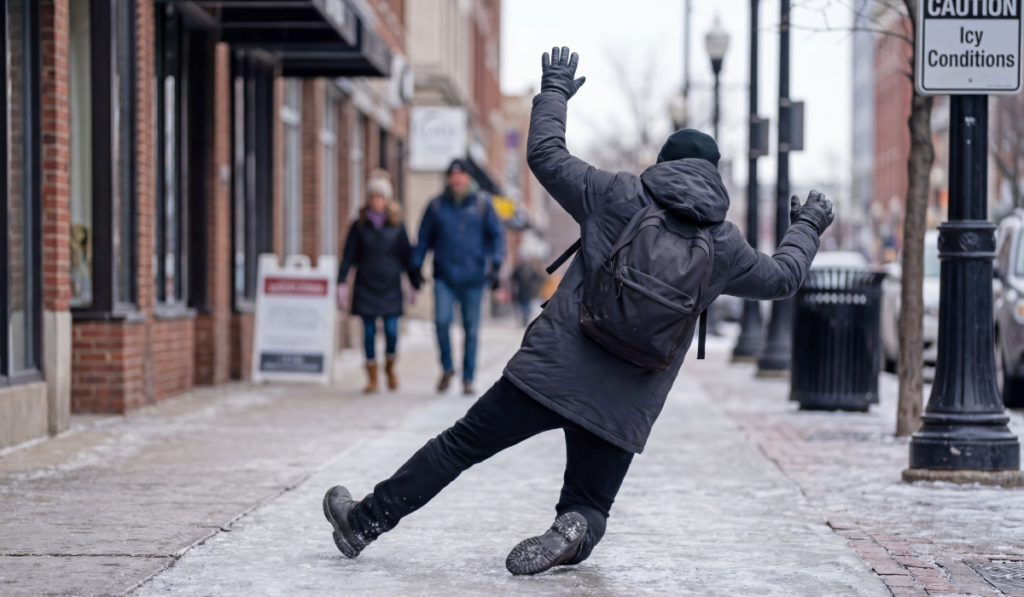
Winter on Long Island transforms our landscape, but it also brings a hidden danger that sends thousands of people to the emergency room each year: ice. A simple walk to the mailbox, a trip to the grocery store, or a commute to work can turn into a life-altering event when property owners fail to maintain safe conditions on their sidewalks.
A sudden slip and fall on an icy patch can cause devastating injuries, from broken bones and concussions to serious spinal cord damage. Victims are often left with immense pain, overwhelming medical bills, and an inability to work. A common misconception is that these incidents are simply “accidents” and that no one is to blame. In New York, this is often not the case. Property owners have a legal duty to keep their premises reasonably safe.
Understanding your rights after a slip and fall is the first step toward recovery. This guide explains the responsibilities of property owners in Nassau and Suffolk counties, what causes these accidents, and the crucial steps you must take to protect your legal claim.
The Legal Duty: Who Is Responsible for Clearing Ice?
When you are injured on someone else’s property, the case falls under an area of law known as premises liability. The core principle is that property owners must address known hazards or dangers they should reasonably have known about. During winter, ice and snow are foreseeable dangers.
In New York, the responsibility for clearing sidewalks can be complex and depends on the specific location of the fall.
Residential Property Owners
For single-family homes, the homeowner is generally responsible for clearing the public sidewalk abutting their property. While local town ordinances may dictate how quickly snow and ice must be removed, the legal liability in a personal injury case often hinges on whether the homeowner’s actions (or inaction) created a more hazardous condition. For example, if a homeowner shovels snow into a pile that later melts and refreezes into a sheet of ice on the walkway, they could be held liable.
Commercial Property Owners
Businesses, retail stores, and shopping malls have a clear duty to keep their premises safe for customers. This includes parking lots, entryways, and walkways. They are expected to have robust procedures for snow and ice removal, including regular inspections, salting, and sanding. A business that fails to take these steps can be found negligent.
Municipalities (Cities and Towns)
In some cases, the town or village itself may be responsible for maintaining certain public sidewalks. However, suing a government entity in New York is incredibly difficult. There are strict requirements, including a “prior written notice” rule. This means you generally cannot sue a municipality for a hazardous sidewalk condition unless they had received prior written notice of that specific defect (like a crack that causes ice to form) and failed to fix it. The deadline to act is also much shorter—you must file a Notice of Claim within just 90 days of the accident.
Proving Negligence: The “Storm in Progress” Defense
One of the most common defenses used by property owners and their insurance companies is the “storm in progress” rule. This legal doctrine states that a property owner’s duty to clear snow and ice is suspended while a winter storm is actively ongoing. They are given a reasonable period of time after the storm has ended to clear the hazardous conditions.
However, this defense is not absolute. An experienced personal injury attorney can challenge it by investigating key questions:
- Was the storm truly “in progress”? We can use meteorological data to prove exactly when precipitation stopped.
- Was the ice from a pre-existing condition? If the ice that caused your fall was present before the storm began, the “storm in progress” rule may not apply.
- Did the property owner’s negligence create the hazard? For instance, if a faulty gutter or downspout consistently pours water onto a walkway that then freezes, the owner’s liability exists regardless of a recent storm.
Steps to Take Immediately After a Slip and Fall on Ice
The moments following a fall are disorienting and painful, but your actions can significantly impact your health and your ability to file a successful claim.
1. Seek Immediate Medical Attention
Your health is the top priority. Call an ambulance if you are in severe pain or cannot move. Even if you feel you can get up, it is vital to see a doctor as soon as possible. Adrenaline can mask the severity of injuries like concussions or internal damage. A medical record creates an official link between your fall and your injuries, which is essential evidence.
2. Document the Scene Thoroughly
If you are physically able, use your phone to take pictures and videos of the accident scene before it changes. Capture:
- The specific patch of ice that caused you to fall.
- The surrounding area to show the general conditions.
- The lack of salt or sand on the ground.
- Any contributing factors, like poor lighting or a downspout leaking water.
- Your footwear and any visible injuries.
Ice melts. A property owner can quickly throw down salt after you leave. Photographic evidence is often the only proof you will have of the hazardous condition.
3. Report the Incident
Notify the property owner, store manager, or landlord about your fall as soon as possible. If it is a business, ask them to fill out an incident report and request a copy. Keep this interaction brief and factual. Do not apologize or accept any blame.
4. Identify Witnesses
If anyone saw you fall, get their name and phone number. An independent witness who can testify about the icy conditions is an incredibly powerful asset for your case.
5. Preserve Your Clothing and Footwear
Do not wash the clothes you were wearing or continue to wear the shoes. Place them in a sealed bag. They can serve as evidence to demonstrate the conditions and counter any claims that your footwear was inappropriate for the weather.
6. Contact a Personal Injury Attorney
Before you speak to any insurance adjusters, consult with a lawyer who specializes in premises liability. The property owner’s insurance company will likely call you quickly, hoping to get a recorded statement they can use against you or offer a quick, lowball settlement. Your attorney will protect you from these tactics.
How The Raimondo Law Firm Fights for You
Winning a slip and fall case requires more than just proving you fell. It requires a thorough investigation to establish that the property owner was negligent.
At The Raimondo Law Firm, we:
- Investigate the property: We immediately send investigators to photograph the scene and identify any code violations or long-standing defects.
- Gather weather data: We obtain certified meteorological reports to prove when a storm ended and establish a timeline for the property owner’s failure to act.
- Secure surveillance footage: We find and preserve video from nearby security cameras that may have captured the fall or the condition of the sidewalk.
- Handle all communications: We take over all contact with insurance companies, allowing you to focus on your medical treatment and recovery.
- Calculate your full damages: We work to ensure you are compensated for all your losses, including current and future medical bills, lost wages, and your pain and suffering.
Don’t Bear the Burden Alone
A fall on the ice is not your fault when a property owner fails in their duty to provide a safe environment. You should not have to bear the financial, physical, and emotional burden of their negligence alone. The legal system provides a way to hold them accountable, but the path is complex and filled with challenges from powerful insurance companies.
If you or a loved one has been injured in a slip and fall accident on an icy sidewalk, do not wait. Speaking with a knowledgeable personal injury attorney can help you understand your next steps and move forward with confidence. To learn more about your legal rights and options, contact The Raimondo Law Firm today at (631) 460-5472 or fill out our online form.Disclaimer: This post is for informational purposes only. Viewing or interacting with this content does not create an attorney–client relationship. For advice specific to your situation, please contact our office directly at 631-471-1222.