
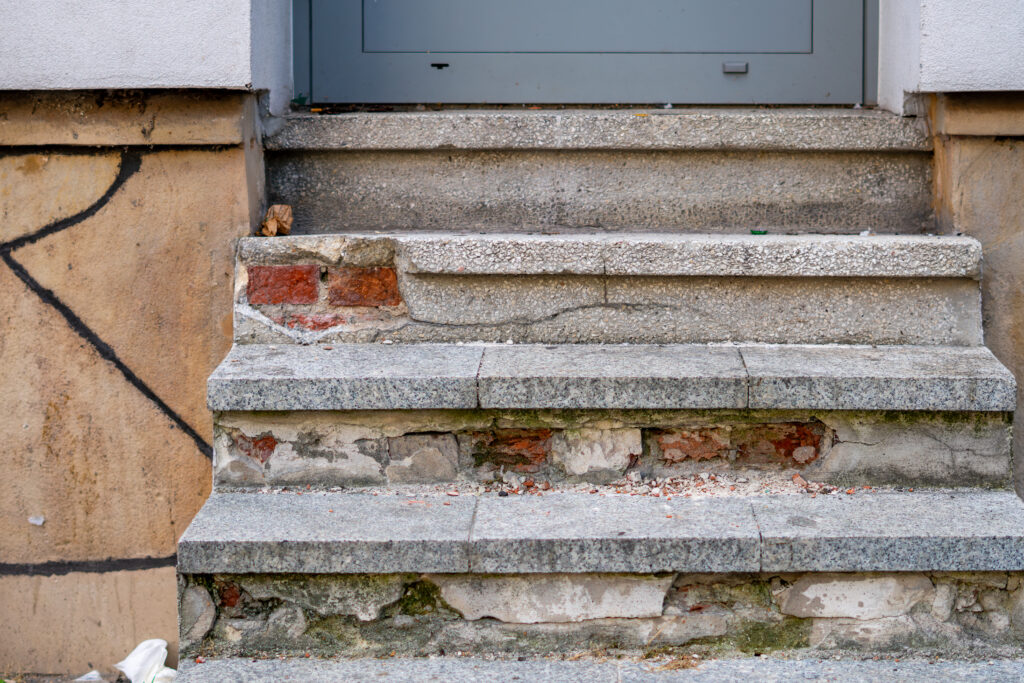
If you were injured because a property was negligently designed or built with a hazard, you don’t need to prove that the owner knew about the danger. New York courts treat defective designs differently from conditions that developed over time. When the hazard can be traced back to the property’s planning, design, or implementation, the act of creating that hazard can be enough to establish liability in an injury lawsuit.
At The Raimondo Law Firm, a Long Island personal injury attorney is ready to help evaluate your case and fight for any compensation you are owed.
Key Takeaways
- The concept of “notice” doesn’t apply to property design defects. If the owner created the hazard, they are typically liable.
- Common examples include poor drainage, bad parking layouts, missing guardrails, and defectively designed stairs.
- Expert testimony is often necessary to prove that the design itself caused your injury.
Why Design Defect Claims Don’t Require Proof of Notice
In most premises liability cases, you would need to show that the property owner had actual or constructive notice of it. The concept of notice means that the owner either knew about the hazard (actual notice), or they should have known about it through reasonable inspection (constructive notice). We explain actual and constructive notice in more detail in this premises liability post.
Cases involving design defects are different. If a hazard exists because of how the property was planned, engineered, or built, the owner or developer created the danger. Courts don’t require the plaintiff to separately prove that the owner knew about a defect in these cases, because the defect is built into the property. Both the defect and the notice effectively become an inseparable fact.
A recent case heard by the New York Supreme Court, Appellate Division, is an example of this theory being applied. In Alpert v. Moinian Group (N.Y. App. Div. 2025), the injured plaintiff fell after losing his balance on a poorly lit staircase. The staircase was 115 inches wide and had only a single handrail installed in the middle. The plaintiff argued that the lack of an additional handrail on such a wide staircase was a factor in the injury. The staircase was poorly designed and violated New York City’s Building Code.
The plaintiff won a summary judgment on liability outright. The staircase was both defective in its design and in violation of the Building Code, so there was no proof of actual or constructive notice required to establish liability.

What Qualifies as a Design Defect on Private Property?
Design defects typically involve hazards that are inherent to a property’s layout or construction, rather than conditions that develop later through neglect, poor maintenance, or other factors.
Examples might include:
- Poor Site Drainage or Grading: This design defect could cause water or ice to consistently pool in walkways or parking areas.
- Dangerous Parking Lot Geometry: Design problems like blind corners, poorly placed permanent bollards, limited separation between pedestrian and vehicle paths, or traffic patterns that create foreseeable collision risks.
- Missing or Inadequate Safety Barriers: Including missing guardrails near drop-off points, lack of barriers around retaining walls, or unmitigated steep curb lines.
- Defective Stairway and Ramp Designs: Improper rise and run ratios, missing handrails, or non-compliant slopes.
- Inadequate Lighting Design: Especially in areas where the design leaves blind or unlit zones.
A recurring water or ice patch caused by a poorly graded surface is an easily relatable defect for locals in Suffolk and Nassau County. If puddling and/or freezing happens because of how a property was built, that’s a design issue, not a maintenance issue.
How Would You Prove That A Design Defect Caused Your Injury?
A design defect claim depends on how the property was built, rather than how it was maintained, so these cases require expert evidence. This means:
- An independent site inspection and measurements, typically with an engineer or design expert. The dimensions, slope, or layout will be measured.
- A comparison to building codes or industry standards is often made, proving how the design deviates from what’s normally required for safe use.
- A link between the defect and the injury is established. This argues that the design flaw, not some other unrelated factor, caused the accident and your injury.
Expert witnesses are essential in these cases, and this is an area where a Long Island personal injury lawyer can leverage a vast network of respected and qualified professionals.
Frequently Asked Questions
Do I Need an Expert Witness for a Design Defect Claim?
Yes, in almost every case, an expert witness is necessary to provide non-speculative, site-specific testimony that establishes how a defect caused a hazard.
Would This Apply to an Apartment Complex or Parking Garage?
Yes, if the property is privately owned, such as a residential complex, retail parking lot, or parking garage, you could potentially build a case on a design defect that caused a hazard and your eventual injury.
Call a Personal Injury Lawyer Who Understands Premises Liability
If you were injured on private property, you may have a viable premises liability case based on an inherent design defect. Even if the design isn’t defective, there are other ways to pursue compensation through the concepts of actual and constructive notice. The Raimondo Law Firm will evaluate your case for free.
Our personal injury legal services are available 24/7. Contact us at (631) 471-1222 today.
